As Technical Director of a high-end peptide synthesis laboratory, our focus is on the precise characterization and application of bioactive molecules. µ-Conotoxin CnIIIC (CAS 936616-33-0), a 22-amino acid peptide derived from Conus consors, is a compound of significant technical interest. While publicly available data heavily emphasizes its cosmetic positioning, a rigorous analysis of its primary pharmacological mechanism reveals a broader potential foundation for professional B2B development. This article distills the available technical specifications and scientific findings to provide a clear profile for research and formulation partners.
Primary Pharmacological Action: Voltage-Gated Sodium Channel (NaV) Antagonism
The defining activity of µ-Conotoxin CnIIIC is its potent and selective blockade of voltage-gated sodium channels. Data indicates high-affinity inhibition of the NaV1.4 subtype (IC50 = 1.3nM), predominant in skeletal muscle, and activity against neuronal NaV1.2 channels. This mechanism is distinct from that of general neurotoxins; it is a highly specific molecular intervention in electrochemical signaling.
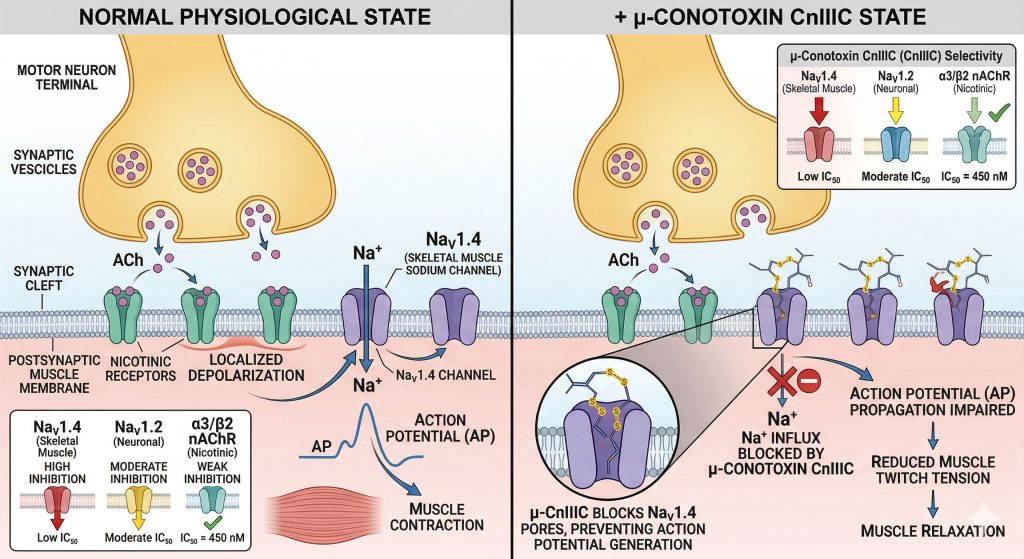
- Technical Implication for R&D: This targeted NaV blockade is the core driver of its documented neuromuscular junction effects, such as decreasing twitch tension IC50= 46-150nM in murine models). For formulators, this translates to a quantifiable, dose-dependent muscle-relaxant effect. The secondary activity of modest nicotinic acetylcholine receptor (alpha3/beta2) inhibition (IC50= 450nM) may contribute to a nuanced modulation of synaptic transmission.
Critical Technical Specifications and Synthesis Considerations
For any serious development work, understanding the compound's physical and chemical parameters is non-negotiable.
- Structure: The sequence is Z-GCCNGPKGCSSKWCRDHARCC-NH₂ (Z = Pyroglutamic acid), stabilized by three specific disulfide bridges (Cys3-Cys15, Cys4-Cys21, Cys10-Cys22). This disulfide framework is absolutely critical for correct folding and biological activity.
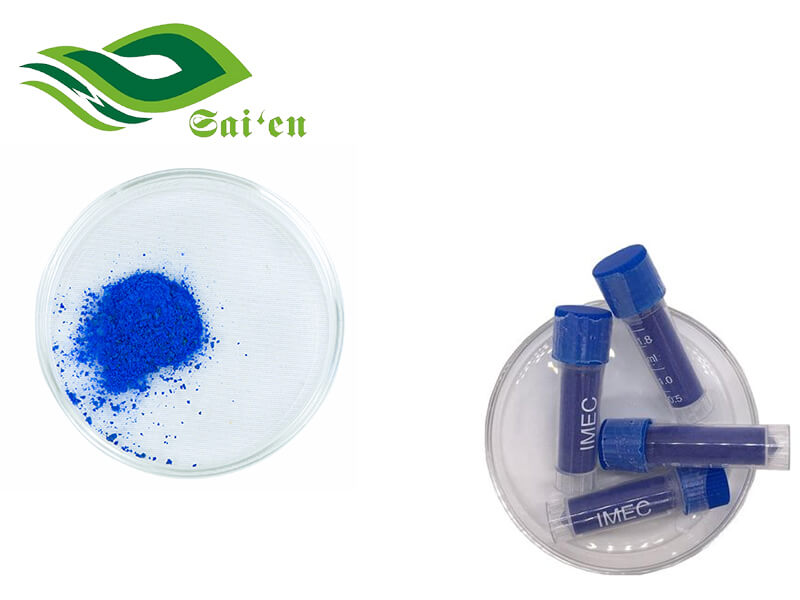
- Synthesis & QC: Reproducible activity requires synthesis via solid-phase peptide synthesis (Boc chemistry) followed by a controlled refolding protocol, typically using a glutathione redox system in guanidinium chloride. Purification to >99% homogeneity via reverse-phase HPLC is standard. Each batch must be verified by ESI-MS (Exact Mass: 2373.89) and bioactivity assays. The peptide is supplied as a lyophilized powder, soluble in aqueous buffers, with recommended long-term storage at -20°C.
Market Positioning and Regulatory Landscape
The current commercial driver is the cosmetics industry, where it is marketed under INCI name S-MU-CONOTOXIN CNIIIC (synonyms: XEP-018, Acetyl Tetrapeptide-9) as a topical muscle relaxant for "instant line reduction." Clinical findings note visible effects on wrinkle depth within hours at 3% concentrations. It is REACH registered (EC 692-855-7) and integrated into premium skincare formulations.

However, the patent landscape (e.g., CN101365716B) and research point to more profound applications. Its potent NaV blockade is a validated pathway for investigating local anesthesia and neuropathic pain management, offering a potential alternative with a different side-effect profile than traditional agents.
Supply Chain and Formulation Notes for B2B Partners
Multiple suppliers in China (e.g., Kebeilai Pharmaceutical Biotech, Wuhan Haorong Biotechnology) offer commercial-scale GMP manufacturing. Key challenges for partners include:
- Batch Consistency: Ensuring identical refolding and purity batch-to-batch is essential for predictable efficacy.
- Formulation Stability: While stable in solution for weeks at 4°C, compatibility studies with excipients and final product pH are necessary.
- Delivery: As a moderately sized (2375.70 Da), charged peptide, achieving optimal dermal delivery may require advanced penetration-enhancing technologies in cosmetic or topical pharmaceutical applications.
Conclusion
µ-Conotoxin CnIIIC (CAS 936616-33-0) is not merely a "Botox-in-a-jar" ingredient. It is a precisely defined peptide neurotoxin with a well-elucidated mechanism of action against specific sodium channel isoforms. For B2B partners in premium cosmetics, it represents a high-activity, biomimetic active requiring rigorous quality control. For those in pharmaceutical development, it represents a promising candidate for targeted neuromuscular and neuronal modulation. Success in either field hinges on respecting its complex biochemistry, investing in stringent quality assurance protocols, and formulating with its specific physicochemical properties in mind.
Its value lies not in hyperbole, but in the exactitude of its interaction with NaV1.4 and related channels—a precision that must be mirrored in its synthesis and application.