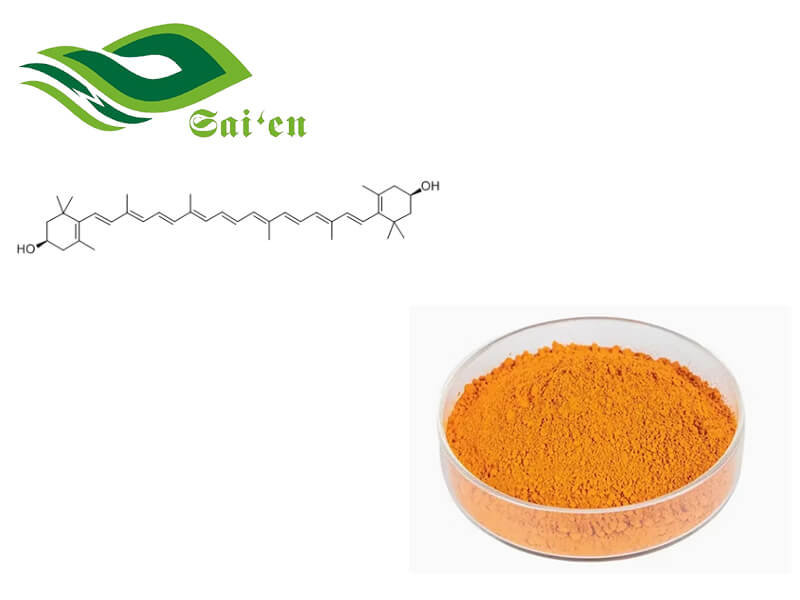
Zeaxanthin is found in many vegetables, edible fish, and shrimp. The human body cannot synthesize zeaxanthin on its own and must obtain it through food or supplements.
Lutein and zeaxanthin are both carotenoids that are found in the macula of the retina of the eye.
Among the many eye protection ingredients, in addition to lutein (lutein esters), zeaxanthin also plays a key role in human eye health. "According to a recent study, children who supplement lutein + zeaxanthin daily for 40 consecutive days can increase macular pigment concentration and better protect vision.
| Zeaxanthin Powder | 5%,10%,20%,70%,98% | Fine Powder | Insoluble in water |
| Zeaxanthin Oil Suspension | 30% | Oil Suspension | Soluble in oil |
| Items | Results |
| Appearance | Orange to yellow powder or crystalline |
| Zeaxanthin Content | 5%, 10%, 20%, 70%, 90%, 98% (by HPLC) |
| Solubility | Insoluble in water; soluble in organic solvents (e.g., ethanol, acetone) |
| Optical Rotation | -80° to -100° |
| Heavy Metals | < 10 ppm |
| Lead (Pb) | < 3 ppm |
| Arsenic (As) | < 1 ppm |
| Cadmium (Cd) | < 1 ppm |
| Mercury (Hg) | < 0.1 ppm |
| Residual Solvents | Complies with USP/NF, EP standards |
| Total Plate Count | <1,000 CFU/g |
| Yeast and Mold | <100 CFU/g |
| E. coli | Negative |
| Salmonella | Negative |
| Staphylococcus aureus | Negative |
| Analytical Method | High-Performance Liquid Chromatography (HPLC) |
| Specification and Type | |
| 5%,10%,20%,70%,98% | Powder&Oil,Tablet,Soft capsule,Hard capsule |
【Product Overview】 We are a premier global supplier of GHRP-6, the foundational First-Generation Growth Hormone Releasing Peptide. As the reference standard against which all newer…
Product Usage: This PRODUCT IS INTENDED AS A RESEARCH CHEMICAL ONLY. This designation allows the use of research chemicals strictly for in vitro testing and…
Premium Peptide Blend for Advanced Cosmetic Formulation Product Overview We are a specialized global supplier of the Matrixyl 3000 (Type) Peptide Complex, the cosmetic industry’s…