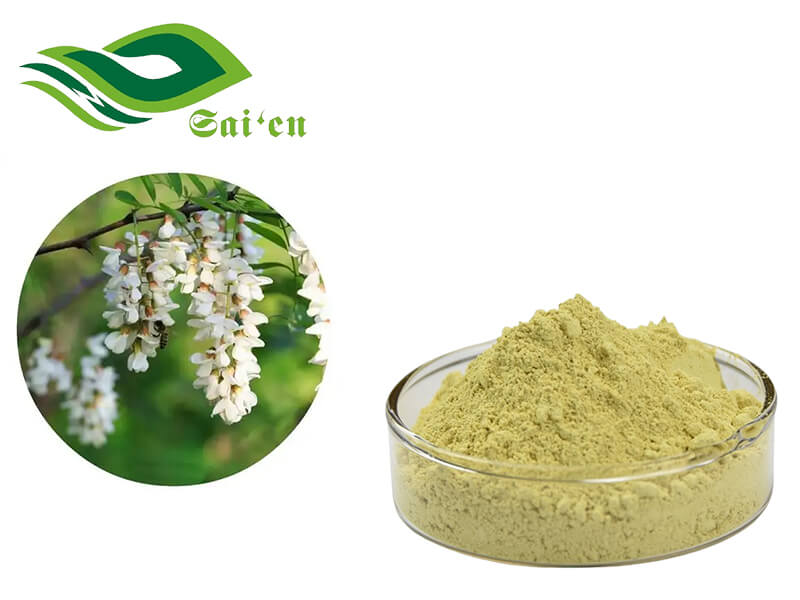
Troxerutin, also known as vitamin P4, is a derivative of flavonoid rutin and can be extracted from Sophora japonica. Rutin is difficult to dissolve in water and difficult to exert its pharmacological activity. In order to solve the water solubility problem of rutin, rutin can be converted into troxerutin through hydroxyethylation technology.
This raw material is easily soluble in water, stable to light and heat, and odorless. The four hydroxyl groups and one rutinose molecule in its molecular structure are the reasons for its biological activity. This product is the main ingredient of many nutritional health products.
| Item | Specification | Results |
| Appearance | Yellowish-green, crystalline powder, hygroscopic | Yellowish-green, crystalline powder, hygroscopic |
| Solubility | Freely soluble in water, slightly soluble in ethanol (96%), and practically insoluble in methylene chloride | Complies |
| Identification | A: IR B: HPLC | Complies |
| Test | ||
| Composition | ||
| - principal Peak Tris(hydroxyethyl) rutin | ≥80% | 88.73% |
| - any other peak | For each peak, maximum 5%, except for 1 peak which can be maximum 10% | Complies |
| Tetrakis(hydroxyethyl) rutin | 4.44% | |
| Mono(hydroxyethyl) rutin | 0.14% | |
| Bis(hydroxyethyl) rutin | 3.09% | |
| Ethylene oxide | ≤1ppm | <1ppm |
| Heavy metals(test F in EP) | ≤20ppm | <20ppm |
| Loss on drying | ≤5.0% | 2.45% |
| Sulfated ashes | ≤0.4% | 0.02% |
| Assay | 95.0%-105.0% | 97.69% |
| Residual solvents | ||
| Methanol | ≤3000ppm | 385ppm |
| Particle size | 100% pass 80 mesh | 100% pass 80 mesh |
| Microbiological test | ||
| Total plate count | ≤1000CFU/G | 60CFU/G |
| Yeast & mould | ≤100CFU/G | Negative |
| Escherichia. Coli | Negative in 1g | Negative |
| Salmonellae | Negative in 10g | Negative |
| Staph. aureus | Negative in 1g | Negative |
| Conclusion | The test results comply with EP8.0 | |
| Storage: | Packed in paper-drums and two plastic-bags inside N.W. 25kgs, store in a well-closed container away from light and moisture | |